How Long Does It Take to Heal Leaky Gut? Set the Retest Date
No calendar answers that. A merely bruised gut lining often recovers with time because it renews within days, but a wall open for years may not close on time alone. The real answer is a dual-sugar urine test repeated on a date set before treatment; the strongest repair-nutrient trial retested at eight weeks.
Feeling better and then stalling for months does not prove a gut cannot heal. More often it means nobody scheduled the measurement that would show whether the wall closed.
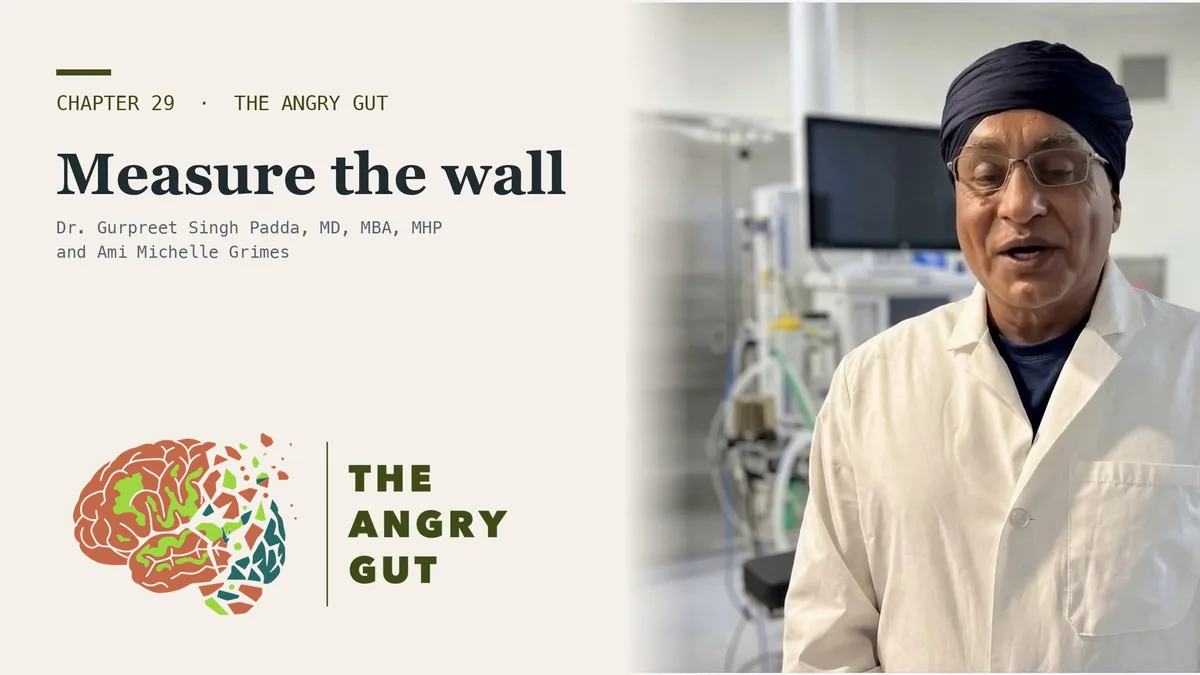
How long does it take to heal leaky gut? No calendar can answer that, and the question tends to hide a missing step. In the video above, A Plateau Is Not a Personality, Dr. Gurpreet Singh Padda, MD, MBA, MHP, walks through Chapter 29 of The Angry Gut, written with Ami Michelle Grimes. The case is a man of forty-five who worked through every step his clinicians set, reached roughly sixty percent better, and then sat there for five months while a urine sugar test kept showing that his gut wall had not closed.
The Angry Gut treats your gut as the first brain, with the second brain sitting in your skull. A wall that stays open keeps feeding metaflammation into both, which is why a plateau deserves a measurement rather than a shrug.
How long does it take to heal leaky gut? Set the date first
For years Dr. Padda gave the standard advice: rest the bowel, eat bland food and give it time, because the lining renews itself within days. For a lining that is merely bruised, that often works. For a wall that has been open for four years, time alone has no end point, because a body cannot rebuild a barrier out of materials it lacks. Think of a crew idling at a job site with no lumber delivery on the schedule.
So the honest answer to how long is conditional. In the strongest trial of a repair nutrient, the course lasted eight weeks and the wall was measured again at the end. In the case from the video, the sugar ratio came back inside range at twelve weeks, for the first time in four years. That is one man, practice-reported figures from our own population, not trial outcomes, and individual results vary. What turned it into a result rather than a feeling was the second measurement, on a date chosen before treatment began.
How do you know if your leaky gut is healing?
That measurement is a dual-sugar urine test. You drink two sugars the body does not break down. Mannitol, the small one, passes through the lining cells, so it reflects how much absorbing surface remains. Lactulose, the larger one, gets across mainly when the seals between cells have loosened. Both leave in the urine over roughly six hours, and dividing one by the other strips out differences in stomach emptying, fluid intake and kidney function. What remains is a number that climbs as the gaps widen. A physician orders it.
A zonulin blood kit cannot stand in for it. Three research teams compared the commonly sold kit with measured permeability and found no meaningful relationship, as explained in how to test for leaky gut. A symptom diary cannot stand in for it either. In a stomach infection trial of a zinc compound, every group reported significant symptom improvement, including the group given antibiotics without any zinc.
Why does leaky gut healing stall?
A plateau can mean the wall is short of supplies. Three shortfalls have human or chemical evidence behind them, at different strengths.
- Zinc. Working from national food supplies rather than blood tests, one model put 17.3% of people worldwide at risk of eating too little zinc. Risk climbed with phytate, the phosphorus store in grains and legumes that locks up zinc before it can be absorbed. The authors asked for people to be measured rather than judged from the map.
- Glycine. A flux calculation for a 70 kg adult found that the body’s own production plus an ordinary diet falls about 10 g a day short of demand, collagen building included. That is arithmetic from published rates, not a shortage seen in a patient.
- Vitamin D. In 27 people with Crohn’s disease in remission, gut permeability held steady on supplementation while the placebo group’s worsened, and those whose blood level climbed to at least 75 nmol/L showed lower inflammation markers. That last finding was an after-the-fact analysis.
The social driver sits on the plate. Low-priced grain and bean staples are what people are told to eat for their health, and they come carrying their own zinc blocker. Glutamine has the strongest trial of any repair material, and the amounts on retail bottles often differ from the amounts studied, which is one more reason none of this belongs in a self-directed plan. Whether a nutrient fits your situation, and at what dose, is a decision for your physician, and so is any change to a medication you already take.
What Measura can measure during a stalled recovery
Measura [Cardiometabolic and Autonomic Health Analysis] does not offer the dual-sugar test, zonulin or any other gut permeability test; those are arranged elsewhere. What it measures is the body the gut wall belongs to. That matters because the people who stall are often the people clinical trials leave out, those with metabolic disease, long medication lists and poor sleep.
- Laboratory panels, chosen with your physician, can show the insulin resistance and inflammation that metaflammation leaves behind. Insulin resistance and metabolic health explains what those numbers mean.
- Bioimpedance body composition separates muscle from fat. If a long gut protocol has narrowed what you eat, that split is worth knowing, because a scale cannot see it.
- Indirect calorimetry measures how much energy your body burns at rest, so you and your physician can compare what you eat with what your body is using while it tries to rebuild. See metabolic rate and energy.
Every finding goes to your physician. Measura measures; it does not diagnose or treat a leaky gut.
Questions to bring to your physician
- Can we measure my gut wall with a dual-sugar urine test before we change anything?
- On what date will we repeat it, and what result would tell us to stop?
- Should my zinc and vitamin D levels be checked instead of assumed?
- Were the doses I have been taking the same doses that were studied?
- Could insulin resistance, body composition or my resting metabolic rate be part of why I stalled?
What happens when bile stops arriving on time is covered in the previous post on bile acid malabsorption, and the next post puts the pieces together as one terrain. Every study behind these numbers, with what each one cannot show, is in the Chapter 29 book companion. Unmeasured is unmanaged, and a plateau with no retest date quietly becomes the new normal.
Frequently asked questions
Can a leaky gut heal on its own?
A lining that is only bruised often recovers with time and fewer irritants, because it renews itself quickly. A wall that has stayed open for years may not, especially if the materials it builds from are in short supply. The only way to know which you have is to measure the wall, then measure it again. Bring that up using questions worth asking your doctor.
Can Measura tell me whether my gut wall has closed?
No. The dual-sugar urine test that reads the gut wall is not a Measura test and is arranged elsewhere by your physician. Measura measures the metabolic terrain around a slow recovery, including laboratory panels, body composition and resting metabolic rate, and sends every result to your physician. For the complete list, read what Measura actually measures.
Is feeling better a sign the gut wall has healed?
Not reliably. In one open-label trial, every group reported significant symptom relief, including a group that never got the supplement being tested. The strongest glutamine trial stands out because symptoms and the measured sugar ratio improved together. Feeling better is welcome, but a repeat test is what confirms the wall. On reading one number wisely, see what a test result can and cannot tell you.
Should I take zinc for leaky gut?
Not on your own. A food-supply model suggests many people worldwide may get too little zinc, especially from diets heavy in grains and legumes, but that says nothing about your level. Ask your physician whether a level should be checked, and whether any dose you are considering matches the dose that was studied. For making sense of a flagged value, see understanding your results.
How often should the gut wall be retested?
There is no fixed rule, but the useful habit is to set the date before treatment starts. The best glutamine trial measured again at eight weeks, the length of its course, and the practice case was rechecked at twelve weeks. Your physician will choose the interval that fits your plan. For how repeat measurements are usually spaced, see how often to repeat testing.
What is the fastest way to heal a leaky gut?
No shortcut replaces knowing whether it is working. Measure the gut wall with a dual-sugar urine test, set the retest date before treatment starts, and ask your physician whether you are short of the materials the wall is built from, such as zinc, glycine or vitamin D. In the strongest repair-nutrient trial, the course lasted eight weeks and the wall was measured again at the end.
Can I test for leaky gut at home?
The kit most often sold, a zonulin blood test, showed no meaningful relationship with measured permeability when three research teams compared them, and a symptom diary cannot stand in either. The test that answers the question is a dual-sugar urine test: you drink two sugars, both leave in the urine over roughly six hours, and the ratio climbs as the gaps widen. A physician orders it.
Does glutamine help heal leaky gut?
Glutamine has the strongest trial of any repair material, and that trial stands out because symptoms and the measured sugar ratio improved together over an eight-week course. The amounts on retail bottles often differ from the amounts studied, so it does not belong in a self-directed plan. Whether it fits your situation, and at what dose, is a decision for your physician.
Measure the body around the gut wall
Request Measura testing to see your metabolic, body composition and resting metabolic rate numbers, and set a retest date with the physician who receives them.
4477 Woodson Rd, Suite 201, St. Louis, MO 63134. Monday to Friday, 9:00 a.m. to 5:00 p.m. Please do not send symptoms, diagnoses or images through a web form — a website form is not a secure medical channel. Send your name and number and we will call you back.
References
- Zhou, Q., Verne, M. L., Fields, J. Z., Lefante, J. J., Basra, S., Salameh, H., & Verne, G. N. (2019). Randomised placebo-controlled trial of dietary glutamine supplements for postinfectious irritable bowel syndrome. Gut, 68(6), 996-1002. https://doi.org/10.1136/gutjnl-2017-315136
- Massier, L., Chakaroun, R., Kovacs, P., & Heiker, J. T. (2021). Blurring the picture in leaky gut research: How shortcomings of zonulin as a biomarker mislead the field of intestinal permeability. Gut, 70(9), 1801-1802. https://doi.org/10.1136/gutjnl-2020-323026
- Tan, B., Luo, H.-Q., Xu, H., Lv, N.-H., Shi, R.-H., Luo, H.-S., Li, J.-S., Ren, J.-L., Zou, Y.-Y., Li, Y.-Q., Ji, F., Fang, J.-Y., & Qian, J.-M. (2017). Polaprezinc combined with clarithromycin-based triple therapy for Helicobacter pylori-associated gastritis: A prospective, multicenter, randomized clinical trial. PLoS One, 12(4), e0175625. https://doi.org/10.1371/journal.pone.0175625
- Wessells, K. R., & Brown, K. H. (2012). Estimating the global prevalence of zinc deficiency: Results based on zinc availability in national food supplies and the prevalence of stunting. PLoS One, 7(11), e50568. https://doi.org/10.1371/journal.pone.0050568
- Meléndez-Hevia, E., De Paz-Lugo, P., Cornish-Bowden, A., & Cárdenas, M. L. (2009). A weak link in metabolism: The metabolic capacity for glycine biosynthesis does not satisfy the need for collagen synthesis. Journal of Biosciences, 34(6), 853-872. https://doi.org/10.1007/s12038-009-0100-9
- Raftery, T., Martineau, A. R., Greiller, C. L., Ghosh, S., McNamara, D., Bennett, K., Meddings, J., & O’Sullivan, M. (2015). Effects of vitamin D supplementation on intestinal permeability, cathelicidin and disease markers in Crohn’s disease: Results from a randomised double-blind placebo-controlled study. United European Gastroenterology Journal, 3(3), 294-302. https://doi.org/10.1177/2050640615572176