
Obesity and heart disease · sick fat
Obesity and Heart Disease: The Weight of Fat and the Sickness of Fat
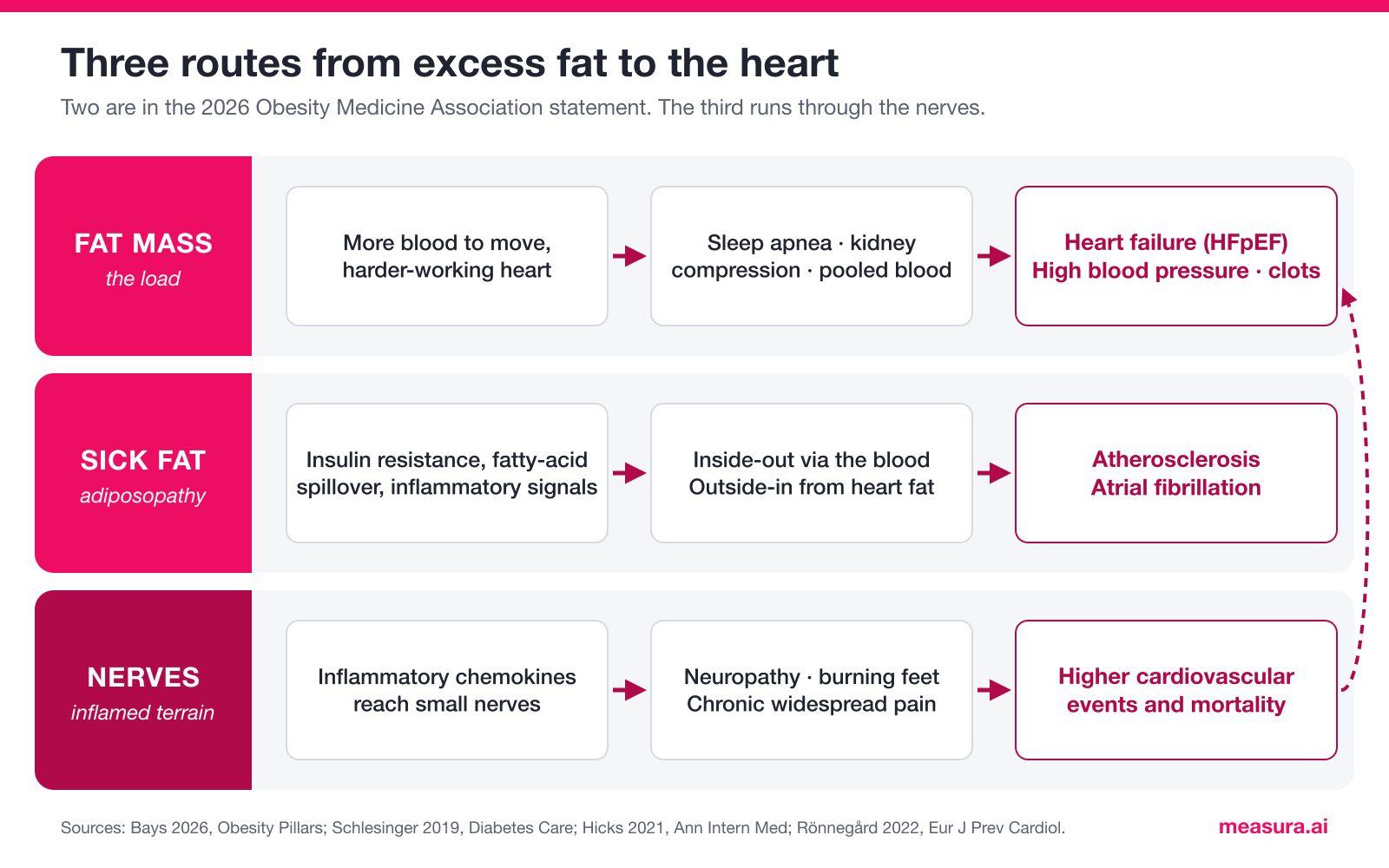
Obesity and heart disease are linked in two ways at once. Fat mass is a physical load: more blood to pump, a stiffer heart, a narrower airway at night. Sick fat, which doctors call adiposopathy, is a chemical problem: fat tissue that has stopped working properly and floods the body with insulin resistance, inflammation and clotting signals. A bathroom scale measures neither.
Most people hear “obesity raises heart risk” and picture a heavy body straining a tired heart. That is half the story, and the less dangerous half. The other half is what the fat is doing while it sits there: talking to your liver, your blood vessels, your pancreas and your nerves in a language of hormones and inflammation. Two people with the same weight can be living two very different stories, and the one with the quieter scale is sometimes the one in more trouble.
What is the difference between fat mass disease and sick fat disease?
In 2026 the Obesity Medicine Association published a clinical practice statement on obesity and cardiovascular disease, written by obesity medicine physicians rather than cardiologists. It runs to 26 sections, and its spine is a simple split. Obesity damages the heart directly through biomechanical “fat mass disease” and through dysfunctional fat on the heart itself. It damages the heart indirectly through adiposopathic immune and endocrine abnormalities that drive type 2 diabetes, high blood pressure, abnormal blood fats and blood clotting.
The term adiposopathy is older than the statement. Its lead author, Harold Bays, laid it out in 2011 as “sick fat”: fat cells and fat tissue that become anatomically and functionally abnormal, and that send out the wrong endocrine and immune signals. The point of the label was to explain something that confused cardiology for years. Excess body fat does not always raise heart risk to the same degree, and in some studies heavier patients seemed to do better. Those “obesity paradoxes” become far less paradoxical once you stop asking how much fat a person carries and start asking how well that fat works.
Think of fat tissue as a warehouse. Fat mass disease is the weight of the inventory bending the floor. Sick fat disease is the warehouse catching fire and blowing smoke into every building on the block.
How does the weight of fat strain the heart?
Fat is living tissue, and living tissue needs blood. The more of it there is, the more blood the heart has to move every minute. Over years, a heart that pumps against that load thickens and loses some of its ability to relax and fill. That pattern is the setup for heart failure with preserved ejection fraction (HFpEF), the kind of heart failure where the squeeze looks normal on an echo and the patient still cannot climb stairs. The OMA statement gives HFpEF, atrial fibrillation and sleep apnea their own sections for this reason.
The load works outside the chest too. Fat around the throat narrows the airway at night, and sleep apnea pushes blood pressure up and destabilizes heart rhythm. Fat packed around the kidneys squeezes them, and the kidneys answer the squeeze by holding salt and raising pressure. Heavy legs that do not move much let blood pool in the veins, which is how clots start. None of that requires the fat to be “sick.” It only has to be there.
How does sick fat inflame the arteries from a distance?
Healthy fat stores energy safely and releases it on cue. Sick fat does neither well. Overfilled fat cells leak fatty acids into the blood, resist insulin’s instruction to hold on to them, and call in immune cells that turn a storage depot into a low-grade wound that never heals. Immunologists call this chronic metabolic inflammation, or metaflammation: the immune system and the metabolism stuck in a loop that feeds obesity, diabetes and the diseases that follow them.
That inflammation reaches the arteries two ways. From the inside, through the blood: inflammatory signals, sticky lipoproteins and a clot-prone state carried to every vessel wall. And from the outside, from fat that sits directly on the heart. Surgeons who took paired samples from 42 patients having bypass surgery found that the fat on the surface of the heart made more of the inflammatory messengers interleukin-1 beta, interleukin-6, MCP-1 and TNF-alpha than the fat under the skin of the same patients. That outside-in injury is the subject of how fat around the heart injures it.
Where do nerves and chronic pain fit in?
This is the branch the standard drawings leave out. The same inflamed terrain that hardens arteries damages small nerves. In a German cohort of 513 adults aged 62 to 81 followed for about six and a half years, obesity raised the odds of developing a sensory neuropathy in the feet by about three and a half times compared with normal weight, and each extra 5 cm of waist added 22% to the odds, with or without diabetes. Part of that effect ran through inflammatory chemokines measured in the blood. In a US study of adults in a weight management program and lean volunteers, neuropathy turned up in 3.8% of lean adults but in 11.1% of adults with obesity whose blood sugar was still normal, and waist size was one of the factors tied to it.
The arrow then turns back toward the heart. In a US national sample of 7,116 adults aged 40 and older, reduced sensation in the feet was tied to higher death rates over 13 years, even in people without diabetes. In the UK Biobank, chronic widespread pain carried a 48% higher risk of heart attack, stroke, heart failure or cardiovascular death after adjusting for the usual risk factors, and the share of cardiovascular disease attributable to chronic pain was comparable with the share attributable to diabetes. Burning feet and an aching body are not a separate file from the heart. They are often the same file, opened at a different page. What a high-sensitivity CRP number says covers the blood marker that sits in the middle of all three branches.
Why is BMI the wrong ruler for heart risk?
BMI divides weight by height squared. It cannot tell muscle from fat, belly fat from hip fat, or quiet fat from inflamed fat. A working group of the International Atherosclerosis Society argued in 2020 that waist circumference adds information BMI misses at every BMI level, and that it should be treated as a vital sign, measured at every visit like blood pressure.
The population numbers show how little the scale explains. Under 12.2% of US adults met optimal metabolic health on NHANES 2009–2016 criteria, and among adults with obesity the figure was 0.5%. Less than a third of normal-weight adults qualified either. By 2017–2018, on tighter cardiometabolic criteria, it was under 7%, with the steepest decline in adiposity. That is the general population, not a clinic’s, and it means most people with a “normal” BMI still carry some of the sick-fat story. How to measure visceral fat walks through the measurements that do see it.
What does “treat obesity first” mean for your heart?
The OMA statement’s central instruction is a change in order. Instead of treating each downstream number separately, one pill for pressure, one for sugar, one for lipids, the statement says to treat the excess and dysfunctional fat that drives all of them, and calls this “treat obesity first”. Adding one more hose for every new fire while the warehouse keeps burning is how the system has worked for decades.
There is now outcome evidence that treating the fat changes the heart. In the SELECT trial, 17,604 adults aged 45 and older with existing cardiovascular disease, a BMI of 27 or more and no diabetes received weekly semaglutide 2.4 mg or placebo. Over a mean of 39.8 months, heart attack, stroke or cardiovascular death occurred in 6.5% on semaglutide and 8.0% on placebo, a 20% relative reduction. GLP-1 medicines may be part of your solution, chosen for specific problems after a full evaluation. They are a tool inside a plan, not the plan.
The plan itself is mostly what happens outside the exam room. Acellular carbohydrates (flour and sugar stripped of the cell walls that slow their absorption) spike insulin, and high insulin keeps fat locked in storage. Industrial seed oils load cell membranes with oxidation-prone fats. Muscle is the largest sink for blood sugar, so losing weight without lifting anything trades fat for sarcopenic wasting and leaves the engine smaller. Short sleep raises the appetite hormones and worsens insulin resistance by morning. And the cheapest calories on the shelf are the ones engineered to be overeaten, so what a neighborhood sells and what a paycheck covers shape a waistline long before willpower enters the picture.
Dr. Padda spent years as a strict vegetarian defending the dietary guidelines he now takes apart, until a bite of beef on a bun at Gates Bar-B-Q in Kansas City ended it. He changed his mind because the physiology told him to. That is the standard for any plan built on these measurements: when the numbers move the wrong way, the plan changes, not the patient’s character.
What can be measured, and what does Measura measure?
- The load. Bioimpedance body composition separates fat from muscle and estimates trunk fat. Indirect calorimetry measures how much energy your body burns at rest and which fuel it prefers, so a nutrition plan starts from your numbers, not a chart.
- The arteries. Ankle-brachial index and arterial stiffness and endothelial function testing look for the vessel damage sick fat produces before it causes symptoms.
- The rhythm control. Heart rate variability and cardiac autonomic reflex tests read the nerves that steer heart rate and blood pressure.
- The nerves. Sudomotor testing checks the small fibers that inflammation damages first.
- The chemistry. Laboratory panels add fasting insulin, inflammation markers and the rest of the metabolic picture.
Measura does not image the heart. When a result calls for an echocardiogram, a CT or a cardiology visit, that is what the report says. For the risk score your doctor already uses and what it leaves out, see ASCVD risk: what the calculator misses. Physicians building this into practice will find the workflow in the adiposopathy screening protocol and the evidence on neuropathy and chronic pain as cardiovascular risk markers.
The so-what is simple. Your weight is one number. Your heart risk lives in a dozen others, most of which can be measured this month and re-measured in three. Knowing which kind of fat problem you have, the load, the fire or both, tells you what to fix first and lets you see whether it is working.
If you have chest pain, pressure, sudden shortness of breath or new weakness on one side, call 911. Measura testing is for planning, not emergencies.
Frequently asked questions
Can a thin person have sick fat?
Yes. In NHANES 2009–2016, less than a third of normal-weight US adults met optimal metabolic health. Fat stored around the organs and inside the liver can be inflamed while total weight looks fine, which is why waist, body composition and insulin tell you more than BMI.
Does losing weight calm sick fat, or just make it smaller?
It calms it. In a 52-week trial in adults with obesity-related heart failure, people who lost an average of 13.3% of their weight on semaglutide saw C-reactive protein, an inflammation marker, fall 43.5%, against 7.3% on placebo. Inflammation followed the fat down.
Is the “obesity paradox” a reason not to worry about weight?
No. The paradox mostly disappears when fat is judged by how it functions rather than how much there is. A heavier person with healthy fat and a lighter person with inflamed visceral fat are not the same risk, and only measurement tells them apart.
Measure both kinds of fat risk
Ask for body composition, vascular and autonomic testing, and the inflammation and insulin markers that show whether your fat is carrying weight or making trouble.
4477 Woodson Rd, Suite 201, St. Louis, MO 63134. Monday to Friday, 9:00 a.m. to 5:00 p.m. Please do not send symptoms, diagnoses or images through a web form — a website form is not a secure medical channel. Send your name and number and we will call you back.
References
- Bays, H. E., Varney, C., Alexander, L., Ng, J., Tondt, J., Weber, C., et al. (2026). Obesity and Cardiovascular Disease: An Obesity Medicine Association (OMA) Clinical Practice Statement (CPS) 2026. Obesity Pillars, 20, 100283. https://doi.org/10.1016/j.obpill.2026.100283 (PMID 42729919)
- Bays, H. E. (2011). Adiposopathy is “sick fat” a cardiovascular disease?. Journal of the American College of Cardiology, 57(25), 2461-2473. https://doi.org/10.1016/j.jacc.2011.02.038 (PMID 21679848)
- Hotamisligil, G. S. (2017). Inflammation, metaflammation and immunometabolic disorders. Nature, 542(7640), 177-185. https://doi.org/10.1038/nature21363 (PMID 28179656)
- Mazurek, T., Zhang, L., Zalewski, A., Mannion, J. D., Diehl, J. T., Arafat, H., et al. (2003). Human epicardial adipose tissue is a source of inflammatory mediators. Circulation, 108(20), 2460-2466. https://doi.org/10.1161/01.CIR.0000099542.57313.C5 (PMID 14581396)
- Schlesinger, S., Herder, C., Kannenberg, J. M., Huth, C., Carstensen-Kirberg, M., Rathmann, W., et al. (2019). General and Abdominal Obesity and Incident Distal Sensorimotor Polyneuropathy: Insights Into Inflammatory Biomarkers as Potential Mediators in the KORA F4/FF4 Cohort. Diabetes Care, 42(2), 240-247. https://doi.org/10.2337/dc18-1842 (PMID 30523031)
- Callaghan, B. C., Xia, R., Reynolds, E., Banerjee, M., Rothberg, A. E., Burant, C. F., et al. (2016). Association Between Metabolic Syndrome Components and Polyneuropathy in an Obese Population. JAMA Neurology, 73(12), 1468-1476. https://doi.org/10.1001/jamaneurol.2016.3745 (PMID 27802497)
- Hicks, C. W., Wang, D., Matsushita, K., Windham, B. G., & Selvin, E. (2021). Peripheral Neuropathy and All-Cause and Cardiovascular Mortality in U.S. Adults : A Prospective Cohort Study. Annals of Internal Medicine, 174(2), 167-174. https://doi.org/10.7326/M20-1340 (PMID 33284680)
- Rönnegård, A.-S., Nowak, C., Äng, B., & Ärnlöv, J. (2022). The association between short-term, chronic localized and chronic widespread pain and risk for cardiovascular disease in the UK Biobank. European Journal of Preventive Cardiology, 29(15), 1994-2002. https://doi.org/10.1093/eurjpc/zwac127 (PMID 35727954)
- Ross, R., Neeland, I. J., Yamashita, S., Shai, I., Seidell, J., Magni, P., et al. (2020). Waist circumference as a vital sign in clinical practice: a Consensus Statement from the IAS and ICCR Working Group on Visceral Obesity. Nature Reviews Endocrinology, 16(3), 177-189. https://doi.org/10.1038/s41574-019-0310-7 (PMID 32020062)
- Araújo, J., Cai, J., & Stevens, J. (2019). Prevalence of Optimal Metabolic Health in American Adults: National Health and Nutrition Examination Survey 2009-2016. Metabolic Syndrome and Related Disorders, 17(1), 46-52. https://doi.org/10.1089/met.2018.0105 (PMID 30484738)
- O’Hearn, M., Lauren, B. N., Wong, J. B., Kim, D. D., & Mozaffarian, D. (2022). Trends and Disparities in Cardiometabolic Health Among U.S. Adults, 1999-2018. Journal of the American College of Cardiology, 80(2), 138-151. https://doi.org/10.1016/j.jacc.2022.04.046 (PMID 35798448)
- Lincoff, A. M., Brown-Frandsen, K., Colhoun, H. M., Deanfield, J., Emerson, S. S., Esbjerg, S., et al. (2023). Semaglutide and Cardiovascular Outcomes in Obesity without Diabetes. New England Journal of Medicine, 389(24), 2221-2232. https://doi.org/10.1056/NEJMoa2307563 (PMID 37952131)
Related reading
- High-Sensitivity CRP: What Your Number Says About Your Heart
- Fat Around the Heart: How Epicardial Fat Injures From the Outside In
- Bioimpedance Body Composition
Medically reviewed by Dr. Gurpreet Singh Padda, MD, MBA, MHP, medical director of Measura. Last reviewed .