
Orthostatic Blood Pressure: What a Seated Reading Misses
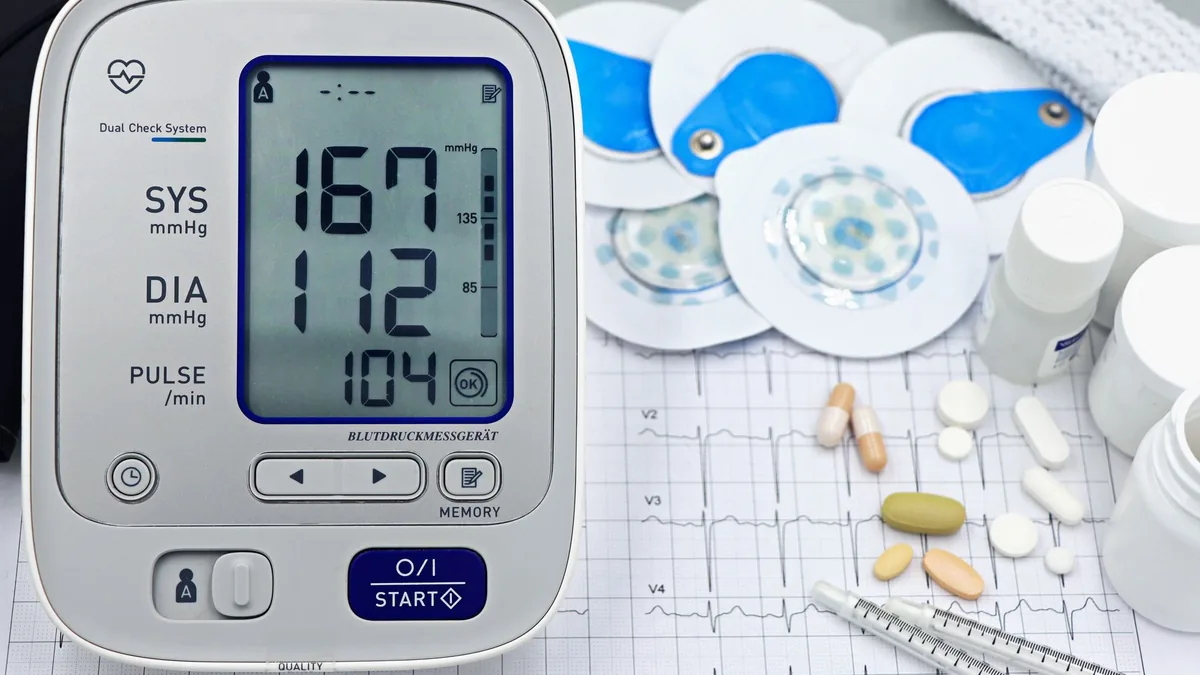
An orthostatic blood pressure reading catches the drop on standing that a seated reading misses, and in older adults that drop is common: pooled across 13 studies of 5,465 people aged 65 and over, continuous tracking found it in 29.0 percent, occasional cuff readings in only 5.6 percent.
Families usually hear a parent’s blood pressure from a reading taken sitting down. In an older adult who falls, grows confused or seems agitated, the number that matters is often the one taken after standing up.
An orthostatic blood pressure is a reading taken at rest and then again after a person stands, to see how far the pressure falls. In an older parent, the gap between those two numbers can explain a fall, a foggy afternoon or a medication list that has grown too long, and a single reading in a chair never reveals it. The video above, Does She Hurt? Pain in the Elderly, covers chapter 16 of The Pained Brain by Dr. Gurpreet Singh Padda, MD, MBA, MHP, and Dr. KrisJay Fucanan, MD. Its subject is pain in people who cannot report it. The measurements that sit beside that problem are the subject here, and the study detail is in the book companion for chapter 16.
What does a seated blood pressure reading miss?
When researchers pooled 13 studies covering 5,465 people aged 65 and over, a drop in pressure on standing showed up in 29.0 percent when pressure was tracked continuously through the move. Checked with occasional cuff readings instead, the same kind of drop showed up in only 5.6 percent. In geriatric outpatient clinics the continuous figure reached 35.2 percent. The people did not change. The method did, and the usual method catches roughly one drop in five.
The drop matters beyond dizziness. Pooled across cohorts, it carried a 1.40-fold risk of death from any cause, and across 15 long-term studies it was linked to a higher rate of later dementia, a hazard of 1.267. These are associations, and the death link weakened in the best-adjusted studies, but they explain why a standing reading belongs in the record of anyone who is falling or slipping mentally.
Can blood pressure pills cause falls in older adults?
Among 4,961 adults over 70 with high blood pressure, followed for three years, moderate-intensity treatment was tied to a 1.40 hazard of a serious fall injury, and in people who had already been hurt in a fall, high-intensity treatment was tied to 2.31. The other side is just as real. Across 46 randomized trials, blood pressure treatment did not increase falls, and a Cochrane review found that withdrawing these drugs pushed systolic pressure up by 9.75 points. In a careful trial of 569 patients with a mean age of 84.8, one drug was removed under a physician’s supervision, and most patients kept their pressure controlled at twelve weeks.
The lesson is not to stop a pill. It is that the decision needs a standing number and a prescriber, together.
When a parent cannot say it hurts
The book opens with an eighty-four-year-old on a memory-care floor whose nighttime agitation was answered with a sedating antipsychotic. She was lying on a fresh spinal compression fracture visible on a scan read for something else, and her pressure on standing ran 30 points under her seated pressure while she took two blood pressure drugs. Pain, fracture and pressure all went unmeasured at the same time, and each one fed the next.
The reporting gap is national. Across 8.6 million nursing-home admissions, pain made it into the record for 68.9 percent of residents who could describe it and for 32.9 percent of those with severe cognitive impairment. The chart holds what gets said, and people with advanced dementia say less. When a Norwegian trial gave a structured pain treatment to 352 residents with dementia and agitation, agitation dropped by 17 percent, and most of those treated, 69 percent, did well on acetaminophen alone.
What measurement can show, and what it cannot
Measura [Cardiometabolic and Autonomic Health Analysis] is a testing service. It measures; it does not treat, and it does not diagnose disease on its own. Results go to your parent’s physician. No test in its library measures pain, and a memory test does not either. What the library can do is put numbers on the conditions that travel with hidden pain and falls.
- Cardiac autonomic reflex tests look at how heart rate and blood pressure respond to position changes and breathing, the reflexes involved when pressure sags on standing.
- Vestibular and balance testing documents steadiness and the inner-ear balance system. That matters because joint pain in two or more sites raised the rate of falls 1.53-fold in adults 70 and older.
- Bioimpedance body composition measures muscle and fat. Sarcopenia, the loss of muscle with age, travels with chronic pain at an odds ratio of 1.52.
- Cognitive assessment sets a baseline for memory and thinking. It does not detect pain. It gives the family and physician a reference point, which matters because persistent pain was linked to 9.2 percent faster memory decline over a decade.
- Laboratory panels describe the metabolic picture. In Americans older than 65, diabetes reaches 29.2 percent and prediabetes 48.8 percent.
Why is orthostatic blood pressure so rarely checked?
Two biological drivers are at work. Blood pressure regulation on standing weakens in many older adults, and the aging body clears drugs slowly, with liver clearance of most medications down 10 to 40 percent, so pressure-lowering and sedating drugs build up. The third driver is the setting. A reading in a chair takes seconds; a standing one takes a second pair of hands and a few extra minutes that a busy floor does not budget. The old body also complains quietly: pain thresholds rise with age, and in one national cohort 12.6 percent of heart attacks arrived without chest pain. Less complaining is not less disease.
The book is candid that the fixes are imperfect too. Repairing a spinal fracture is contested, and taking drugs away on its own did not reliably prevent falls in community trials. Measurement does not settle those questions. It makes sure they get asked. Dizziness and the risk of falling covers the fall side in more depth.
What should you ask if a parent is falling, confused or agitated?
- Has her blood pressure been taken standing as well as sitting, and how was it measured?
- Has anyone checked for pain by watching her move, instead of asking a question she cannot answer?
- Has any recent scan, even one taken for a cough, been looked at for a spinal fracture?
- Has her muscle or grip strength been measured, and is there a memory baseline to compare against later?
- Is any medication treating a symptom that another medication might be causing?
Keep every medication decision with the prescriber; the standing reading is where that conversation begins. Memory and cognitive screening explains what a baseline is for, and physicians can read delirium in elderly patients and the pain workup.
Frequently asked questions
What does an orthostatic blood pressure test show?
It shows how much blood pressure falls when someone moves to standing. In pooled studies of adults 65 and over, a drop appeared in 29.0 percent when pressure was tracked continuously and in 5.6 percent with occasional readings, so the method changes the answer. The result helps a physician think about falls, dizziness and how strong blood pressure treatment should be. Autonomic symptoms describes related warning signs.
Can blood pressure medicine cause falls in older adults?
It can contribute. In 4,961 adults over 70, moderate-intensity treatment was linked to more serious fall injuries, and the link was stronger in people already injured by a fall. Pooled randomized trials showed no rise in falls, and stopping treatment raises pressure, so the safe route is a supervised review with the prescriber, never stopping on your own. Dizziness, balance and falls covers the balance side.
Can a cognitive test tell whether someone with dementia is in pain?
No. A cognitive assessment measures memory and thinking, not pain. Pain in a person who cannot describe it is judged by watching how they move and react during care, and by searching for a cause such as a fracture. A cognitive baseline still helps, because it gives the physician a reference when confusion suddenly worsens. Cognitive assessment describes what the test covers.
Why does untreated pain matter so much in dementia?
In a trial of 352 nursing-home residents with dementia and agitation, treating pain reduced agitation by 17 percent, and the agitation drifted back when the painkillers stopped. Pain has also been linked to faster memory decline and more falls in older adults. New agitation deserves a search for pain before anyone reaches for a sedative. Cognitive screening: what a baseline is for explains why the comparison point matters.
Does Measura treat the problems it finds?
No. Measura measures circulation, autonomic function, balance, body composition, metabolism and cognition, and sends the results to the physician who ordered them. Any decision about medications, procedures or pain treatment stays with that physician and the family. Understanding your results explains what the report contains and what happens next.
How is orthostatic blood pressure taken?
Blood pressure is read at rest and then again after the person stands, to see how far it falls. How the standing number is captured matters. In pooled studies of adults 65 and over, continuous tracking through the move found a drop in 29.0 percent, while occasional cuff readings found it in only 5.6 percent. A standing reading needs a second pair of hands and a few extra minutes.
Why would a doctor check orthostatic blood pressure?
Because a seated reading can hide the drop that explains a fall, a foggy afternoon or new agitation in an older adult. The drop on standing has been linked to a higher risk of death and of later dementia. A standing number also gives the prescriber what is needed to judge whether blood pressure or sedating medications are adding to the problem.
What causes blood pressure to drop on standing in older adults?
Two biological drivers are at work. Blood pressure control on standing weakens in many older adults, and the aging body clears drugs slowly, with liver clearance of most medications down 10 to 40 percent, so pressure-lowering and sedating drugs build up. In the book’s case, an eighty-four-year-old taking two blood pressure drugs ran 30 points lower standing than sitting.
Ask for the standing number
If an older family member is falling, confused or newly agitated, ask about autonomic, balance and cognitive baseline testing. Measura sends every result to the ordering physician.
4477 Woodson Rd, Suite 201, St. Louis, MO 63134. Monday to Friday, 9:00 a.m. to 5:00 p.m. Please do not send symptoms, diagnoses or images through a web form — a website form is not a secure medical channel. Send your name and number and we will call you back.
References
- Tran, J., Hillebrand, S. L., Meskers, C. G. M., Iseli, R. K., & Maier, A. B. (2021). Prevalence of initial orthostatic hypotension in older adults: a systematic review and meta-analysis. Age and Ageing, 50(5), 1520-1528. https://doi.org/10.1093/ageing/afab090
- Duval, G. T., Raud, E., Gohier, H., Dramé, M., Tabue-Teguo, M., & Annweiler, C. (2023). Orthostatic hypotension and cognitive impairment: Systematic review and meta-analysis of longitudinal studies. Maturitas, 185, 107866. https://doi.org/10.1016/j.maturitas.2023.107866
- Tinetti, M. E., Han, L., Lee, D. S., McAvay, G. J., Peduzzi, P., Gross, C. P., Zhou, B., & Lin, H. (2014). Antihypertensive medications and serious fall injuries in a nationally representative sample of older adults. JAMA Internal Medicine, 174(4), 588-595. https://doi.org/10.1001/jamainternmed.2013.14764
- Reddin, C., Murphy, R., Hanrahan, C., Loughlin, E., Ferguson, J., Judge, C., Waters, R., Canavan, M., Kenny, R. A., & O’Donnell, M. (2023). Randomised controlled trials of antihypertensive therapy: does exclusion of orthostatic hypotension alter treatment effect? A systematic review and meta-analysis. Age and Ageing, 52(4), afad044. https://doi.org/10.1093/ageing/afad044
- Gnjidic, D., Langford, A. V., Jordan, V., Sawan, M., Sheppard, J. P., Thompson, W., Todd, A., Hopper, I., Hilmer, S. N., & Reeve, E. (2025). Withdrawal of antihypertensive drugs in older people. The Cochrane Database of Systematic Reviews, 3(3), CD012572. https://doi.org/10.1002/14651858.CD012572.pub3
- Dube, C. E., Morrison, R. A., Mack, D. S., Jesdale, B. M., Nunes, A. P., Liu, S.-H., & Lapane, K. L. (2020). Prevalence of Pain on Admission by Level of Cognitive Impairment in Nursing Homes. Journal of Pain Research, 13, 2663-2672. https://doi.org/10.2147/JPR.S270689
- Husebo, B. S., Ballard, C., Sandvik, R., Nilsen, O. B., & Aarsland, D. (2011). Efficacy of treating pain to reduce behavioural disturbances in residents of nursing homes with dementia: cluster randomised clinical trial. BMJ, 343, d4065. https://doi.org/10.1136/bmj.d4065
- Leveille, S. G., Jones, R. N., Kiely, D. K., Hausdorff, J. M., Shmerling, R. H., Guralnik, J. M., Kiel, D. P., Lipsitz, L. A., & Bean, J. F. (2009). Chronic musculoskeletal pain and the occurrence of falls in an older population. JAMA, 302(20), 2214-21. https://doi.org/10.1001/jama.2009.1738
- Whitlock, E. L., Diaz-Ramirez, L. G., Glymour, M. M., Boscardin, W. J., Covinsky, K. E., & Smith, A. K. (2017). Association Between Persistent Pain and Memory Decline and Dementia in a Longitudinal Cohort of Elders. JAMA Internal Medicine, 177(8), 1146-1153. https://doi.org/10.1001/jamainternmed.2017.1622
- Chen, J., Wang, X., & Xu, Z. (2023). Sarcopenia and Chronic Pain in the Elderly: A Systematic Review and Meta-Analysis. J Pain Res, 16, 3569-3581. https://doi.org/10.2147/JPR.S435866